





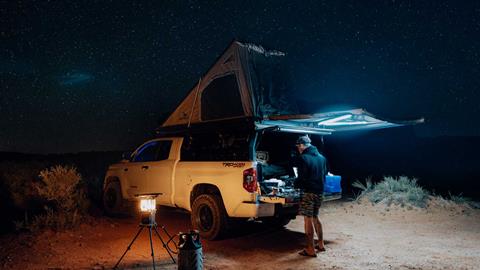
Built from aircraft-grade aluminum extrusions and designed by an owner who lived out of his truck in the Arctic Circle, the Dirtbox Overland Canopy Camper is engineered to take a beating — and keep you comfortable while it does. We put one through its paces across 30 nights in the field to find out if it lives up to the hype.
Dirtbox Overland Canopy Camper Review
In the overland space, there is no shortage of canopy campers. In fact, it seems like every year at Overland Expo another company arrives with a new take on the truck bed camper. With so many choices, it can be difficult to know which designs actually work once they leave the show floor.
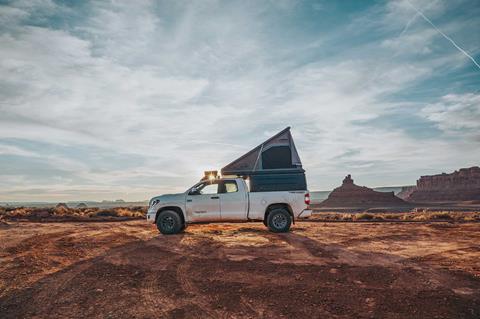
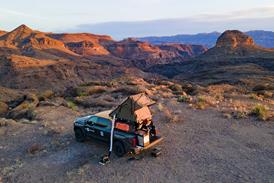
I’ve been running the Dirtbox Overland Canopy Camper on my 2020 Toyota Tundra with a 6.5-foot bed since September 2025. The long bed gives me plenty of living space—which is one reason I bought it in the first place—and over the years I’ve slept in several different campers for work.
After roughly 30 nights in this one, the Dirtbox and its surrounding ecosystem have become some of my favorites.
Aluminum Construction Built for Hard Use
Dirtbox builds its Canopy Camper from a combination of T5 and T6 aluminum extrusions. The construction allows the company to use relatively thin material without sacrificing rigidity, helping control weight while maintaining structural strength.
Aluminum also brings the obvious advantages of corrosion resistance and an ability to handle exposure to widely varying temperatures.
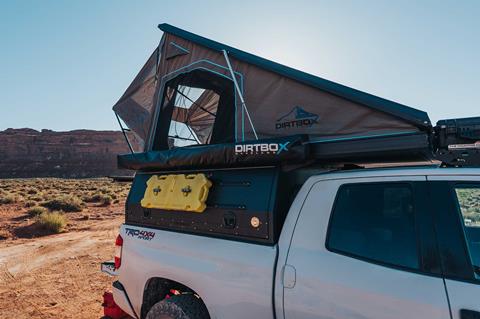
It isn’t the lightest aluminum truck camper on the market. The camper on my Tundra weighs just under 400 pounds, but there is a reassuring solidity to the entire structure.
Dirtbox even has a camper at its shop that had a redwood tree fall on it. According to the company, the damage was largely confined to the tent portion, which could be repaired without replacing the main structure.
That emphasis on durability reflects the background of Tao Guo, one of Dirtbox Overland’s owners and the camper’s designer. Before launching the company, Guo spent years traveling throughout the American West, exploring trails and camping in all kinds of conditions. That included several months living out of his truck in the Arctic Circle. The Canopy Camper feels like a product shaped by that experience rather than something designed solely around a specification sheet.
Design Details That Set It Apart
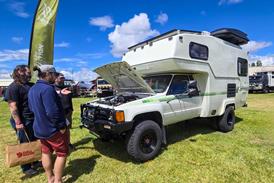
The Dirtbox has a distinctive shape. Where many canopy campers use relatively straight vertical walls, its sides incorporate a hexagonal bend. The design contributes additional structural rigidity while giving the camper an appearance that immediately separates it from many of its competitors.
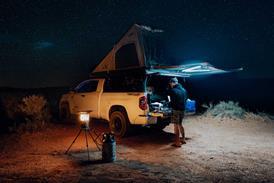
Up top is a wedge-style tent, and setup is about as easy as I have experienced with this type of camper. With the top raised on my long-bed Tundra, I can stand toward the front of the bed near the cab and still have plenty of headroom.
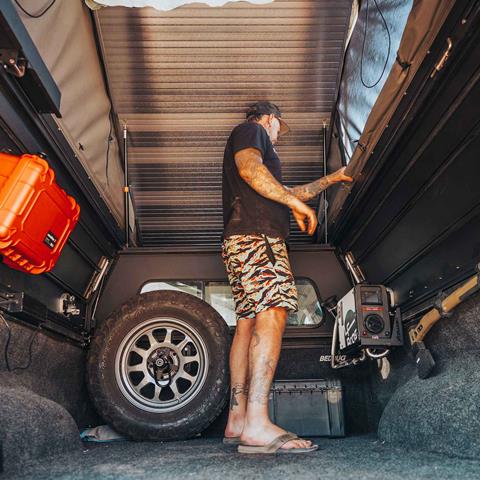
Sleeping space is similarly generous. At 6 feet tall, I can stretch out comfortably without using the front extension. Taller owners—or those using the camper on a shorter-bed truck—can fold down the passthrough and add the included mattress section, which matches the thickness of the main sleeping pad and extends the bed forward.
Folding down the passthrough also closes off the sleeping area from the lower camper, essentially creating a darkened upper room.
The tent material has held up well in bad weather. I’ve had the camper open through heavy rain during a tornado watch without experiencing leaks or moisture problems. The sleeping platform lifts and stays overhead with the assistance of struts, creating usable standing room below.
There is also enough room to leave bedding in place when everything is closed. I currently run an additional 3-inch memory foam pad beneath the supplied mattress and can still close the camper with my bedding and pillows inside. That saves a surprising amount of effort when breaking camp.
Storage and Mounting Options
The camper has gullwing doors on both sides, providing wide access to the truck bed. Inside, T-track runs along the walls and lower portions of the camper, making it easy to add Molle panels, brackets, and other accessories without permanently modifying the structure.
One of my favorite small details is the door hardware. Rather than the push-button locks commonly found on canopy campers and truck toppers, Dirtbox uses whale-tail latches. Closing the latch pulls the door firmly against the seal while helping protect the lock mechanism from silt, ice, and road salt.
Anyone who has tried to operate a lock packed with trail dust or frozen precipitation will appreciate the difference.
The exterior of the gullwing doors also comes standard with L-track, adding another place to mount equipment. Owners planning to put substantial weight on the doors may want to upgrade to stronger struts so the panels remain securely open.
The extrusion-based structure also makes it relatively simple to customize the outside of the camper. T-track runs along the upper exterior, providing mounting points for awnings, showers, water storage, lighting, and other overland equipment.
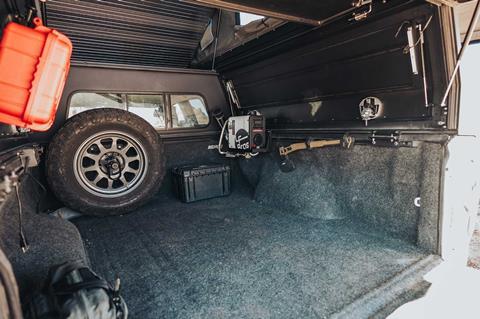
Installing the Dirtbox meant I could no longer use the full-length roof rack previously fitted to my Tundra—not that the portion beneath the camper would have remained very useful anyway.
I switched to a shorter Sherpa rack above the cab, which still gives me enough space to carry several storage cases using brackets from The Mounting Company.
Standard Features: What Comes With the Dirtbox Canopy Camper
There is a useful amount of equipment included from the start. My camper has six integrated lights: two dimmable lights on each gullwing door, one over the rear opening, and another in the sleeping area.
A third brake light and marker lights are also wired into the rear of the camper. Upstairs, USB charging ports and a 12-volt socket provide convenient power for phones and smaller accessories.
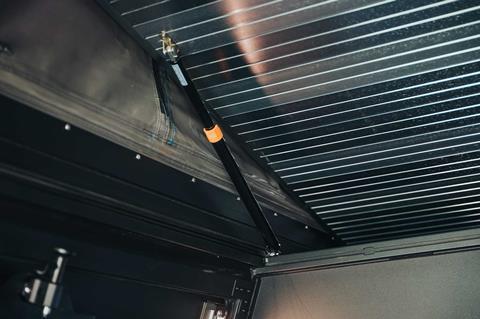
L-track and T-track mounting systems are standard, as is the mattress. An insulated roof panel helps reduce heat transfer, keeping the sleeping area cooler during hot weather and helping retain warmth on colder nights.
For a truck bed camper that can be configured in so many different ways, I appreciate that Dirtbox provides the basic infrastructure and leaves owners plenty of room to decide how elaborate—or how simple—they want the interior to become.
Power and Electrical Options
Low on the driver’s side is the camper’s main power box, which includes charging connections and can be configured with an AC/DC converter or hardwired into a secondary battery system.
Once a reliable power source is connected, the camper provides a good starting point for an off-grid setup without requiring you to tear apart the interior to add basic wiring.
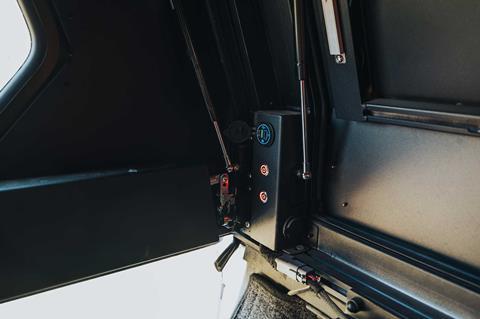
I installed the AC/DC converter and use an EcoFlow portable power station to run the camper lighting, heater, and awning lights. It has been a simple arrangement that fits the way I use the truck without requiring a permanent, elaborate electrical system.
Real-World Testing: Around 30 Nights in the Dirtbox
I have intentionally kept the inside of my camper relatively minimal. My Tundra still needs to function as a truck, so maintaining an open and usable bed is important to me.
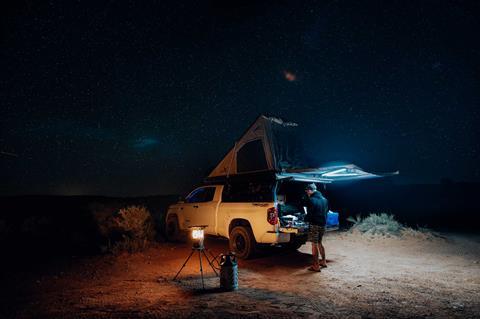
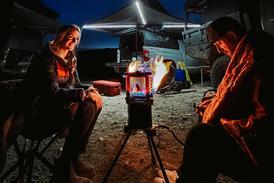
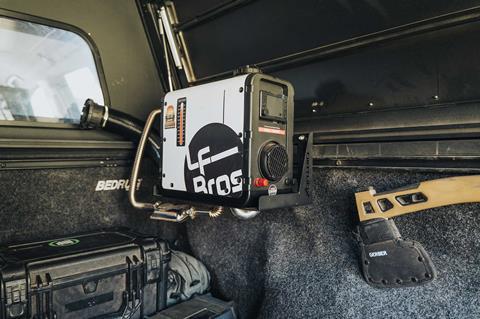
Since picking up the Dirtbox in September 2025, I’ve spent approximately 30 nights in it across a fairly wide range of temperatures. For colder conditions, I added an LF Bros diesel heater using Dirtbox’s dedicated heater bracket.
The bracket keeps the heater secure while traveling over rough roads and incorporates an exhaust port that passes through the camper wall. The heater brings the interior up to temperature quickly, and the camper does a good job of holding that heat once everything is closed.
I’ve also added Molle panels to both gullwing doors, which give me places to mount traction boards, a shovel, and RotopaX containers. Inside, the T-track works with hardware from The Mounting Company and has made it easy to organize gear without committing to permanent cabinetry.
The basic truck camper setup remains flexible enough that I can unload equipment when I need the full bed and reinstall it for longer trips.
Easy Setup Matters More Than You Think
One detail I’ve come to appreciate is how easily the tent material folds back into place when closing the camper. There is enough room around the sleeping area for the fabric to collapse neatly without requiring you to walk around the truck continuously tucking material inside.
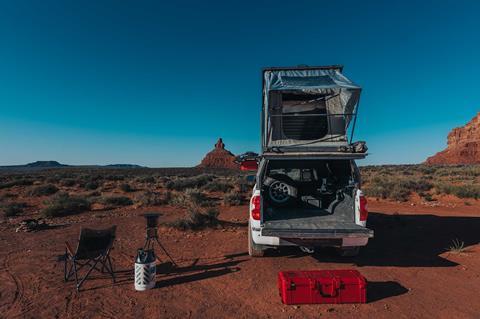
I have used other wedge tent campers where closing the roof becomes a repetitive process of lowering it slightly, walking around to stuff fabric inward, and trying again. It may seem like a minor detail, but when you are packing up camp day after day, those small inconveniences add up quickly.
With the Dirtbox, opening and closing camp remains fast enough that I don’t hesitate to deploy the tent even during shorter overnight stops.
The Dirtbox Ecosystem
Another reason I chose the Canopy Camper was Dirtbox Overland’s growing ecosystem of accessories.
I was already using the company’s 270-degree awning on my previous topper, and it transferred directly to the camper. For the way I travel, it has become one of my most useful accessories. Add the optional wall kit and the covered space can become a substantially more protected living area when wind or rain moves in.
That compatibility also makes it easier to build the camper progressively instead of designing the entire system on day one. Owners can start with a relatively empty canopy and add storage, heating, electrical components, awnings, and mounting systems as their needs become clearer.
Durability ultimately played an equally important role in my decision. I wanted a camper I wouldn’t feel compelled to baby every time a trail narrowed or the weather turned ugly. After seeing examples that had endured hail, tree branches, rocks, and other abuse, the Dirtbox seemed well suited to years of actual backcountry use.
What Could Be Better
There is a lot I like about the Dirtbox Canopy Camper, but after living with it for months, there are a few things I would change.
The biggest is the rear hatch. Opening it requires reaching toward both sides and operating two levers simultaneously. It works, but it isn’t especially convenient, particularly when your hands are full. Some type of central release that could be operated with one hand would make day-to-day use considerably easier.
The supplied rear ladder also became more trouble than it was worth for me. After spending a few months dealing with it occasionally sliding out of its pin, I eventually removed it and put it in the garage.
I also encountered a rattle between one section of T-track and the door panel. Fortunately, that was an easy fix. A few strips of foam tape between the track and panel eliminated the noise completely.
None of these issues has fundamentally changed the way I feel about the camper, but they are worth knowing if you are considering one. A useful canopy camper review should cover the frustrations along with the features that work well.
Living With the Dirtbox Canopy Camper
After roughly 30 nights, what stands out most about the Dirtbox isn’t one headline feature. It is how well the different parts work together.
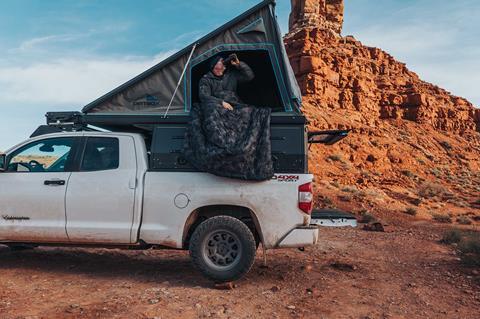
The camper is sturdy without feeling excessively complicated, the wedge tent opens and closes quickly, the mounting tracks make customization straightforward, and the largely open interior lets me continue using my Tundra as a pickup when I’m not camping.
It isn’t the lightest option, and there are a few details I would like to see refined, particularly the rear hatch and ladder. But for someone looking for a durable overland truck camper that can start simple and evolve as their needs change, the Dirtbox Canopy Camper offers a particularly well-thought-out foundation.
Weight: Just under 400 lbs. as tested
Price: Starting at $10,500 for a 5-foot-bed model
Access More Great Stories!
For more informative articles like this, consider subscribing to OVR Magazine in print or digital versions here. You can also find the print edition of OVR at your local newsstand by using our Magazine Finder.


No comments yet